Buying property in another country requires a somewhat different approach than buying a home where you live permanently. In Turkey, choosing the property itself is only part of the process. It is equally important to define your purpose, budget, location requirements and the property characteristics that actually matter to you before you start looking.
For one buyer, being close to the sea and having a comfortable home for several months of the year may be the priority. For another, access to the metro, schools and hospitals may matter most. An investor, meanwhile, will look at rental demand, liquidity and future resale potential. That is why it is better to start the search with clear criteria rather than with a specific residential project.
In this guide, we explain how to approach buying property in Turkey from the initial decision through to selecting a specific property. You will learn how to define your goals, choose the right location, establish your search criteria, compare properties and identify the questions that should be answered before paying a deposit. Legal matters, required documents, purchase costs, TAPU and buying property with a power of attorney are covered in separate guides within this section.
Where to Start When Buying Property in Turkey
One of the common mistakes made by first-time buyers is starting with property listings.
When you open a property catalogue, you quickly see dozens of seemingly similar apartments: different districts, prices, sizes, distances to the sea, amenities and payment terms. After a while, it becomes difficult to understand why one property is actually suitable while another is not.
The first step, therefore, is to determine what you need the property to achieve.
Clearly Define Your Purpose
Before choosing a city or residential project, answer one simple question:
Why are you buying the property?
There may be several different scenarios.
For Permanent Residence
In this case, everyday convenience matters: the district, transport, schools, healthcare, shops, local infrastructure, layout and quality of the building.
For Holidays
Here, proximity to the sea, climate, local infrastructure, airport accessibility, a terrace or balcony and the convenience of using the property throughout the year may become more important.
For Long-Term Rental
In this case, you need to consider not only how attractive the apartment is, but also who is likely to rent it in this location: local residents, families, students, professionals, international tenants or other groups.
For Investment and Future Resale
Here, it is particularly important to assess the property's liquidity, location, project quality, local demand and how easily the property could be sold in the future.
For a Combination of Purposes
In practice, this is also a common approach: an owner may live in the apartment for several months of the year and rent it out during the remaining period. In this case, the criteria should be selected to support both purposes.
Define Your Purpose Before You Start Searching
Write down one main purpose and no more than two additional ones.
For example:
Main purpose: permanent residence
Additional purpose: long-term rental
Priority: a district with well-developed infrastructure and good transport connections
This simple definition can already narrow down your search considerably.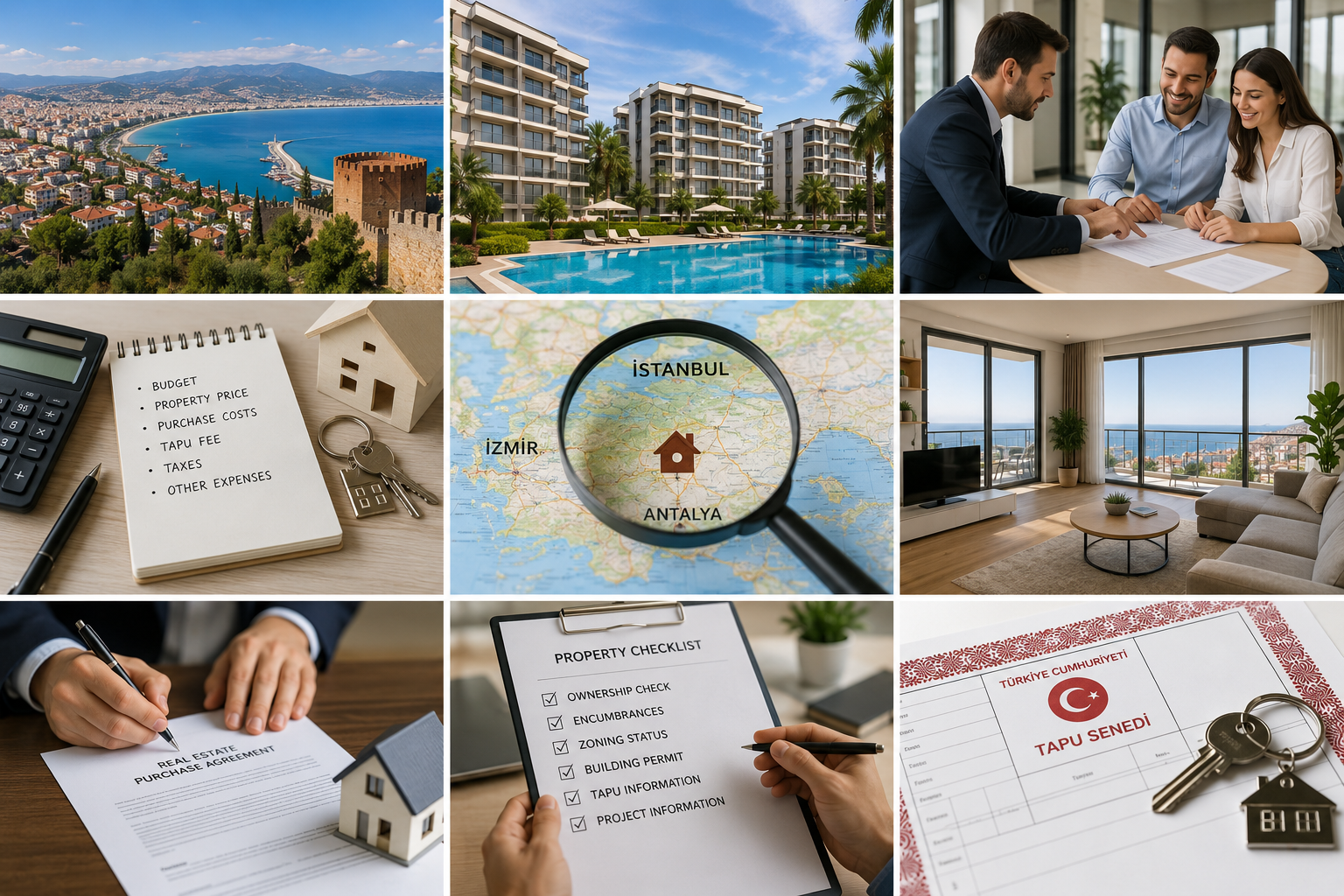
Define Your Budget, Not Just the Property Price
Your budget for buying property in Turkey should include more than the property price. Before starting your search, consider your maximum purchase price, down payment, instalment plan, additional purchase costs and the reserve you want to keep after the purchase.
Distinguish between your actual budget and your ideal budget. A higher-priced property is not necessarily a better choice — always compare the price with the location, features, quality and benefits you receive.
For more information about property purchase costs in Turkey, see our dedicated guide: Property Purchase Costs in Turkey.
Define Your Property Criteria
Once you have established your purpose and budget, the next step is to turn your preferences into clear criteria.
It is useful to divide them into three groups.
Essential Criteria
Things the property must have for you to consider it suitable. For example, a specific city, two bedrooms, a maximum distance from the sea, a balcony, parking or a specific budget limit.
Desirable Criteria
Features that would be beneficial but that you could compromise on. For example, a swimming pool, SPA, sea view, proximity to a shopping centre or a large terrace.
Criteria You Can Compromise On
This helps prevent you from rejecting suitable properties simply because they do not meet one secondary preference.
Practical Checklist Before Buying
Before viewing properties, fill in:
| Criterion | My choice |
|---|---|
| Purpose | Permanent residence / rental / investment |
| Budget | €___ |
| City | ___ |
| District | ___ |
| Property type | Apartment / villa / commercial property |
| Layout | ___ |
| Minimum size | ___ m² |
| Maximum distance to the sea | ___ |
| Transport | ___ |
| Balcony / terrace | Yes / No |
| Parking | Yes / No |
| Completion status | Ready / off-plan |
| Instalment plan | Yes / No |
| Additional preferences | ___ |
It is a simple table, but it can make comparing properties much easier.
How to Choose a Location in Turkey
Once your criteria are defined, you can move on to choosing the right city and district. The key question is not “Which city in Turkey is the best?” but rather “Which location is best suited to my purpose?” There is no single answer, as the same district may offer different advantages for permanent residence and short-term rental.
When comparing locations, consider transport connections, distance to the sea, everyday infrastructure, schools and universities, healthcare facilities, shopping centres, the quality of surrounding development, rental demand, typical buyer and tenant profiles, and future development potential.
Demirağ Property offers dedicated location pages where you can explore the characteristics, lifestyle and real estate opportunities of different cities and districts in more detail.
Do Not Compare Apartments Only by Price Per Square Metre
Price per square metre can be a useful reference point when comparing properties, but in Turkey it does not, by itself, determine the real value of a property. Two apartments with the same size can have very different prices, and this does not necessarily mean that one of them is overpriced.
The value of a property depends on a combination of factors: the location of the land, the characteristics of the location itself, demand, the number of comparable properties available in the area, distance to the sea, metro stations, shopping centres and other strategically important points. What the development itself offers also has a significant impact. Underground parking, high-quality amenities, swimming pools, SPA facilities, modern engineering systems, smart home technology, premium finishing materials and other features can all influence the property's value.
The characteristics of the apartment itself are equally important: floor, view, layout, orientation, condition, terrace or balcony size and other parameters. For this reason, it is more accurate to compare the value of a specific property in a specific location while considering all of its characteristics rather than simply comparing the price per square metre.
Price negotiations should also be taken into account. Some developers, but certainly not all, may have policies under which the initially quoted price can be reconsidered when a buyer is ready to proceed and negotiations begin. This depends on the individual project, the developer's policy, payment terms and other circumstances. Therefore, the published price is not always the final price, but it would also be incorrect to assume that a discount is automatically available.
This is where the experience of a professional becomes particularly valuable. A specialist who knows the market, understands the situation with a particular project and has experience negotiating on behalf of buyers can help you assess the real value of a property, compare alternatives and work towards reasonable purchase terms.
We are always on the buyer's side. For us, trust is the main capital of Demirağ Property, and it is what we invest in our work every day.
What to Check Before Paying a Deposit
Once you have found a suitable property, you should not move directly to payment simply because you like the apartment.
Before proceeding with the purchase, it is important to verify the available information about the property and the terms of the transaction. Official sources recommend checking for restrictions such as mortgages, attachments and other encumbrances that may affect a sale. It is also important to understand that TAPU information is not publicly accessible. Unlike in some countries, third parties in Turkey cannot freely obtain information about another person's property. Therefore, property verification is carried out as part of the transaction process, based on documents provided by the seller and through official procedures involving the owner or an authorised representative.
At this stage, you should have clear answers to the following questions:
- Who is the registered owner?
- Are there any encumbrances?
- What exactly is being purchased?
- What is included in the price?
- What are the payment terms?
- When will the property be handed over?
- What obligations of the parties are stated in the contract?
- How will ownership be registered?
One important point is that a preliminary contract or written agreement by itself does not transfer ownership. In Turkey, ownership of real estate arises upon registration with the Land Registry.
For more information about documents, purchase costs and TAPU, see the dedicated guides in this section.
How the Property Purchase Process Works in Turkey
Once you have defined your goals, budget and property criteria and selected a suitable property, the purchase moves into the transaction stage. This normally includes property and document checks, agreeing the purchase terms, preparing the necessary documents, making payments and registering ownership with the Land Registry.
The exact process depends on whether you are buying from a private owner, a developer or purchasing a property under construction, as well as on the payment structure and stage of the project.
Read the full step-by-step guide to the property purchase process in Turkey →
In theory, a buyer can handle all these stages independently. In practice, professional support can make the process easier, faster and more reliable: there are fewer organisational issues to deal with, less risk of overlooking an important detail and greater clarity about what is happening at each stage.
We can be there from the first click to the completion of the transaction. Our role is to make buying property in Turkey clear, well-organised and as comfortable as possible for the buyer.