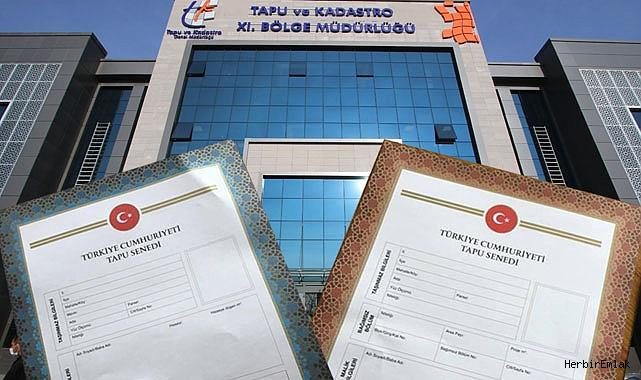
What Is TAPU in Turkey?
TAPU, or Tapu Senedi, is the document associated with registered ownership of real estate in Turkey.
The Turkish land and property registration system has a long history. The first modern land registry organisation was established during the Ottoman Empire in 1847, and the system continued to develop after the establishment of the Republic of Turkey. Today, property registration and cadastral records are managed by the General Directorate of Land Registry and Cadastre (Tapu ve Kadastro Genel Müdürlüğü — TKGM).
For the buyer, the most important point is this: state protection of property ownership begins after the ownership is registered in the TAPU. A sale and purchase agreement, even if notarised, does not by itself transfer ownership of real estate. Ownership passes to the buyer after it is registered in the land registry and the TAPU is issued in the buyer's name.
What Information Is Shown in a TAPU?
A TAPU contains information that identifies the land, the specific independent unit and the registered ownership rights.
Unlike the address format commonly used in many countries — street, building number and apartment number — a TAPU primarily uses cadastral and land registry information.
The document may include: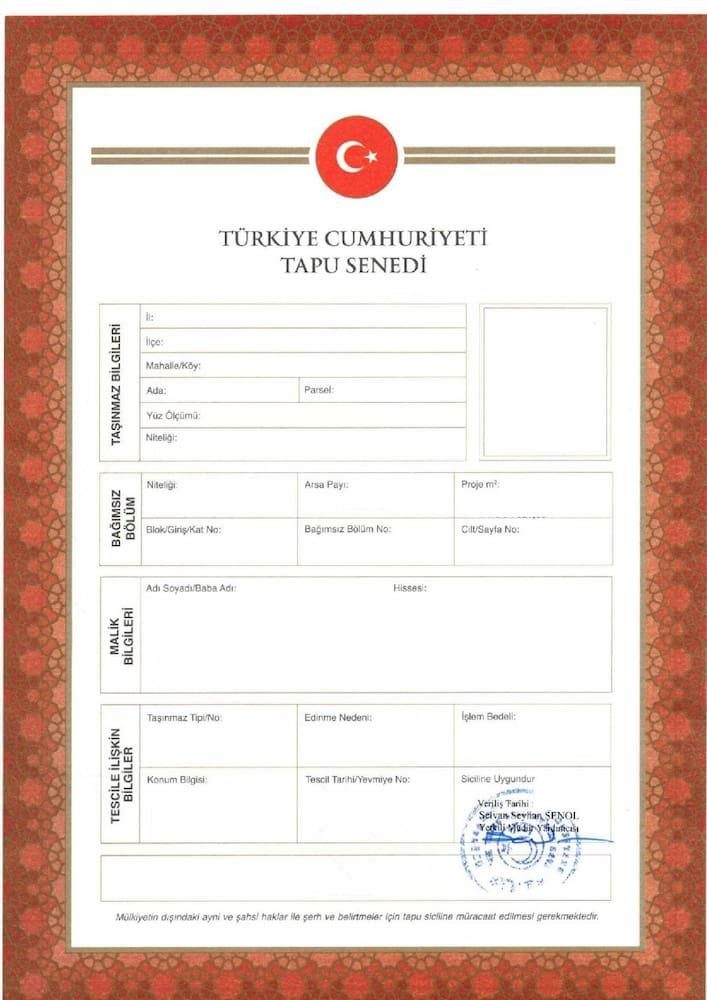
İl — province
İlçe — district
Mahalle — neighbourhood
Ada — cadastral block
Parsel — parcel number
Blok — building block, where applicable
Bağımsız Bölüm No — independent unit number
Malik — registered owner
Hisse — ownership share
Arsa Payı — land share belonging to the independent unit
Yüzölçümü — registered land area
Edinme Sebebi — basis of acquisition
Yevmiye No — registration journal number
Tarih — registration date
The TAPU may also show the registered transaction value and other registration information.
It is important to understand that the land area shown in the TAPU is not the same as the apartment's internal floor area. The apartment is registered as a separate independent unit, together with its corresponding share of the land.
What Are Kat İrtifakı and Kat Mülkiyeti?
When buying property in Turkey, foreign buyers often encounter two terms: Kat İrtifakı and Kat Mülkiyeti.
What Is Kat İrtifakı?
Kat İrtifakı is a registered right connected to a future independent unit in a planned or developing building.
This status is often encountered when buying property during construction or before the final registration procedures for the building have been completed.
What Is Kat Mülkiyeti?
Kat Mülkiyeti is registered ownership of a completed independent unit.
For a completed apartment, this generally means that the apartment is registered as a separate property.
The exact status should always be checked against the current registration records rather than determined from the appearance or age of the building.
What Is Aile Konutu Şerhi?
Aile Konutu Şerhi is a special annotation in the land registry relating to property used as the family home.
This can be important even when the property is registered 100% in the name of one spouse. If such an annotation exists, the rights of the other spouse may need to be taken into account when the property is sold or otherwise disposed of.
Therefore, seeing that one person owns 100% of a property does not always tell the complete story. Registered annotations and restrictions should also be checked.
What Encumbrances Can Be Registered on a TAPU?
A TAPU and the land registry may contain mortgages, restrictions, third-party rights and other registered encumbrances.
The existence of an encumbrance does not necessarily mean that the property cannot be sold. What matters is understanding what has been registered, who holds the relevant right and how the matter will be resolved as part of the transaction.
For example, under certain circumstances, a mortgage may continue to affect the property after ownership has been transferred to a new owner.
This is why it is important to check not only the Tapu Senedi itself, but also the current registered rights and restrictions affecting the property.
Can Property Ownership Be Challenged or Cancelled?
A registered transaction is not normally cancelled simply because someone later disagrees with it. There must be a legal basis and an appropriate legal procedure.
One specific example is the pre-emption right (önalım hakkı) in cases of shared ownership. Under certain circumstances, if one co-owner sells their share to a third party, the other co-owners may have a legal right to purchase that share under the conditions established by law.
Such situations are not common when buying a separately registered apartment. They are more relevant to properties held in shared ownership, including some land transactions.
For this reason, when purchasing property with multiple registered owners, it is important to understand the ownership structure and registered shares in advance.
Can TAPU Be Registered Before Full Payment?
In some transactions, particularly when buying property from a developer through an instalment plan, the parties may agree to register the TAPU in the buyer's name before the full purchase price has been paid.
For example, the buyer may pay an agreed portion of the purchase price, after which ownership is registered in the buyer's name, while the remaining amount is secured by a registered encumbrance on the property until the balance is paid in full.
This is not a universal rule. The arrangement depends on the developer, the contract, the instalment terms and the security agreed for the remaining payment.
In other words, ownership registration and the obligation to pay the remaining balance can sometimes exist at the same time, but this must be specifically agreed and properly registered.
How to Check TAPU Information
Before the transaction, it is important to request a Takyidat Yazısı — an up-to-date extract from the land registry.
It shows not only the current registered owner, but also registered mortgages, attachments, restrictions, annotations and other rights affecting the property.
The document can be obtained through the Turkish government's e-Devlet system. For a buyer, it is much more informative than simply looking at the TAPU provided by the seller because the Takyidat Yazısı gives a current overview of the registered rights and encumbrances relating to the property.
Demirağ Property checks this information as part of the transaction preparation so that the buyer understands not only who owns the property, but also whether there are any registered restrictions before the purchase.
What Should Be Checked After TAPU Registration?
Once the registration has been completed, the buyer becomes the registered owner of the relevant property and its corresponding share of the land.
The TAPU is issued as part of the completed registration process. Demirağ Property recommends checking the new owner's full name, the block and independent unit number, the registered land share and the registered property value, along with the other key registration details.
How Demirağ Property Helps With TAPU
Buyers who purchase property through Demirağ Property do not need to understand every stage of the TAPU process or remember the entire sequence of procedures themselves.
We check the documents in advance, coordinate the process and accompany the transaction so that ownership is registered correctly and the buyer receives a legally clear property without unexpected issues in the documentation.
In many cases, our clients also give power of attorney to Demirağ Property. This allows us not only to arrange the registration of the property in the buyer's name, but also to handle the subsequent registration of necessary utility services.
As a result, the client does not need to visit government offices, municipalities, utility providers and other organisations personally. We organise these procedures on the client's behalf.
The process is therefore as comfortable as possible for the buyer: we handle the organisational side, while the client receives property registered in their name and ready for use.
For more information about buying property through a power of attorney, see our dedicated guide: Buying Property with Power of Attorney.